


Quick Dive: The Multiverse - Infinite Realms and Infinite Possibilities
- Jackson Null
- Jun 12, 2023
- 5 min read

Remember the scene in Monster's Inc. where we see a seemingly endless warehouse of doors, each leading to a different child's bedroom in a different part of the world? Now, let's take that concept a step further.

Imagine that each door doesn't lead to a different room, but to an entirely different universe - welcome to the idea of the multiverse.
Much like the infinite doors in Monster's Inc., the multiverse proposes that our universe is just one among countless others, each with its own unique set of laws, history, and perhaps even dimensions. This idea not only challenges our understanding of our place in existence, but also expands our imagination to the realm of the infinite.
In this article, we will navigate this fascinating concept in a way that you can find interesting, entertaining, and at the very least- comprehensible. Starting with the origins of the multiverse idea, we will explore the scientific theories supporting it, discuss recent developments, ponder its implications, and finally, reflect on the questions it leaves us with. Our journey into the multiverse won't require a scare floor or a closet door, just a curious mind. Ready? Let's open the door!
The Making of the Multiverse Concept
The multiverse theory didn't pop out of nowhere. It grew over time, helped by many great minds. One early idea came from physicist Hugh Everett in the mid-20th century. He proposed many worlds to explain the strange behavior of quantum mechanics, like how light can act as both a particle and a wave.

String theory is another important part of the story. In this theory, all
particles are tiny strings that vibrate. As the strings vibrate differently, they create different particles.
This idea allows for many universes, each with its own dimensions and rules. Physicists like Brian Greene and Leonard Susskind have dedicated much of their work to understanding the way this idea functions within the universe.
The multiverse also helps with big questions in physics. For example, why does our universe seem so perfectly set up for life? The multiverse offers a new answer: with so many universes, it's not strange that one of them has the right conditions for life. It's less like a miracle and more like winning a big cosmic lottery.
The idea of a multiverse has come a long way over the years. One big turning point was when inflation theory was accepted in the 1980s. This theory, which explains why the cosmic microwave background radiation is so uniform, also suggests a huge cosmos filled with many different "bubble universes". This helped the multiverse become a serious idea in science.
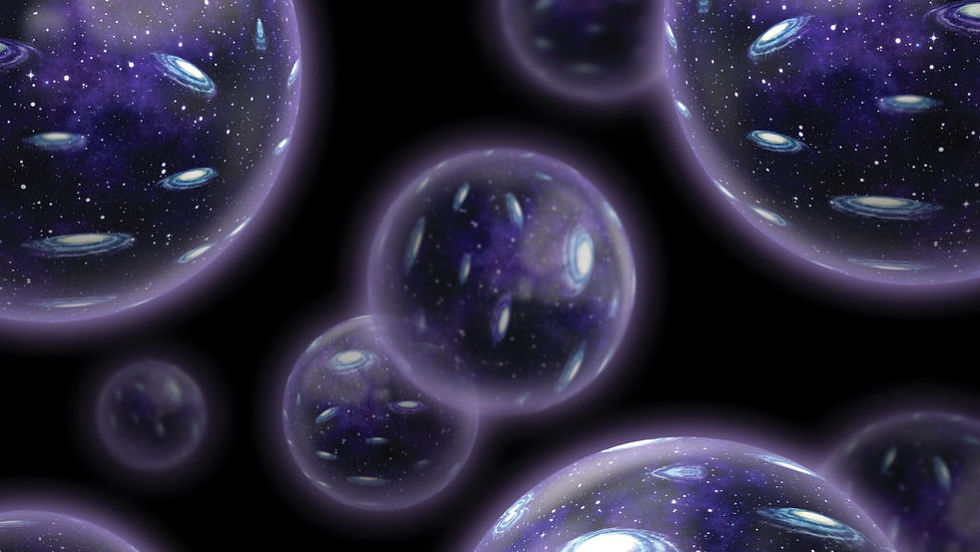
The exploration of the multiverse concept is still ongoing. While we have not directly observed other universes, their existence is a logical consequence of our current understanding of physics. As our knowledge evolves, we may find further indirect evidence of these "many worlds", challenging our perceptions and understanding of reality.
Building Blocks of The Multiverse
Quantum superposition and extra dimensions are two key ideas that help explain the multiverse:
Quantum superposition is the idea that a particle can be in two places at once until observed. It's like a coin that's both heads and tails at the same time, until you look at it.
Extra dimensions come from string theory with different vibrations making different particles. It's like different notes coming from the same guitar string.
These two ideas are connected. Many worlds, an idea in quantum mechanics, says that all possible quantum outcomes are realized in some universe. So if quantum superposition means a particle can be in two separate locations in time and space at the same time, then many worlds says there are two universes: one for each location the particle can be.

The multiverse is not just a place where anything can happen. Each universe follows its own rules, and those rules come from the string vibrations or quantum states that created them. The multiverse is not a free-for-all; it's an infinite collection of distinct, rule-abiding universes.
It's worth noting that the multiverse is not just some "fun" idea from science fiction. It comes from serious theories in physics. It's not proven, but it's not just a wild guess either. Understanding the multiverse requires a careful look at the strange world of quantum mechanics and the vibrating strings of string theory.
Progress and Challenges in Understanding the Multiverse
Studying the multiverse is currently an impossible task. While there have been theoretical advancements, empirical evidence or recent discoveries directly linked to it are still out of reach. The primary challenge is testing. Multiverse theories often involve scales or dimensions that are beyond our current technological capabilities. To even begin to test these theories, we'd need to observe effects from other universes on our own.
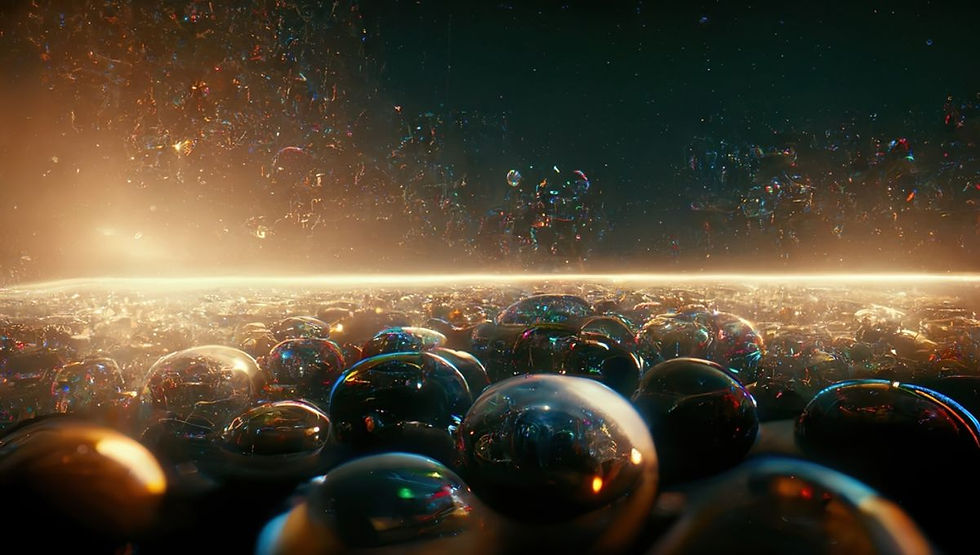
The sheer enormity of these theories and the potential number of universes they suggest can be staggering, creating massive hurdles in developing a cohesive and testable theory. Some physicists speculate that it may take decades, or even centuries, to develop the necessary technology and mathematical frameworks to fully understand the multiverse.
But, even with these challenges, the study of the multiverse is very important. It helps us to push the limits of what we know and makes us question what we think about the natural world. This means that there might be some really exciting developments in the future of studying space.
Multiverse Implications: From Physics to Philosophy
The concept of a multiverse can have a profound effect on our understanding of reality and steer the future of physics in new directions.
Think of the laws of physics as we currently understand them as akin to the rules in a board game. But what if each 'game' has its own distinct rules? According to multiverse theory, our universe is merely one game in an infinite library, each with unique rules.
These theories stir up complex philosophical conversations that need to be had- it's not just about our universe being one among many, but also about what it means for our existence and identity.
If there are countless versions of reality, each with its own set of possibilities, it challenges our perception of individuality and uniqueness. Almost like being characters in a book, and there are countless versions of your same book with slightly different plots. This perspective can affect how we view our actions, decisions, and lives, raising questions about determinism, free will, and destiny.
The multiverse concept also opens up exciting possibilities for technological advancement, specifically in the field of quantum computing. Quantum computing, which uses the peculiar properties of quantum particles to perform complex computations rapidly, could see significant advancements if we were to harness the potential of other universes.

But why is this important for us? Well, quantum computing could revolutionize several sectors, from healthcare, where it could lead to the development of new drugs and better diagnostic methods, to finance, where it could optimize trading strategies, to climate modeling, where it could help create more accurate models.
Wrapping Up the Multiverse
We've journeyed through the concept of the multiverse, examining its implications in physics, technology, and philosophy. Also, we've compared the laws of physics in different universes to varied rules in an infinite library of board games, pondered on what the existence of multiple realities means for our personal identity, and speculated on the exciting possibilities that advancements in quantum computing could bring about if we were able to tap into the properties of other universes.
The notion of a multiverse is more than a theoretical construct; it has the potential to reshape our understanding of reality and the fundamental laws that govern it.
If there exist infinite universes with infinite possibilities, might there be a universe where the laws of physics are so drastically different that life as we know it could take on a completely different form, and if so, what would that tell us about the nature of existence itself?


Comments